

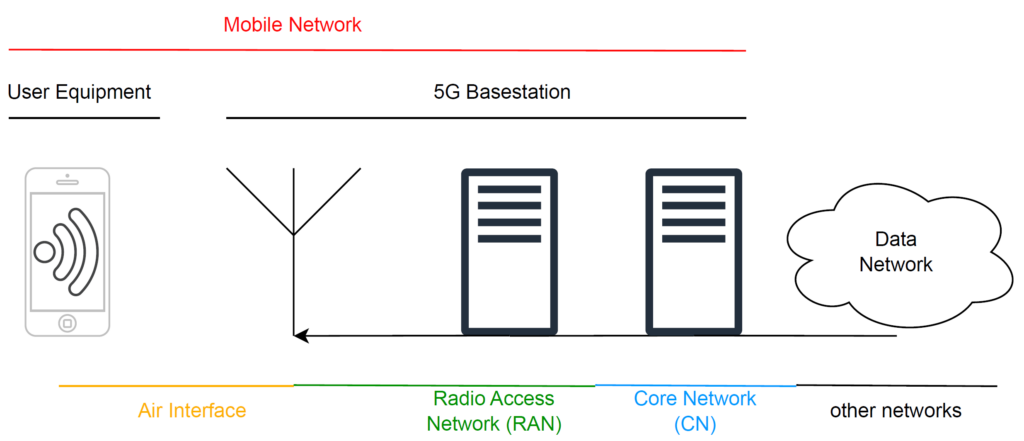
A 5G Non-Public-Network (5G NPN) consists of different components which are all available in the testbed. The first component is the user equipment (UE), this is most easily described as a smartphone with a SIM-Card. The SIM-Card is the identifier and cryptographic device, required to access the network. Via cellular technology the user equipment connects to the 5G base station, where one or multiple cells can be deployed. The 5G base station consists of two primary components: the Radio Access Network (RAN) and the Core Network (CN). The RAN can utilize either commercially available hardware (COTS) or application-specific integrated circuits (ASICs). In contrast, the CN exclusively employs COTS hardware across all testbeds. The CN encompasses various network functions, including authentication and mobility management, session management, user data management, policy control, and the gateway to other data networks.
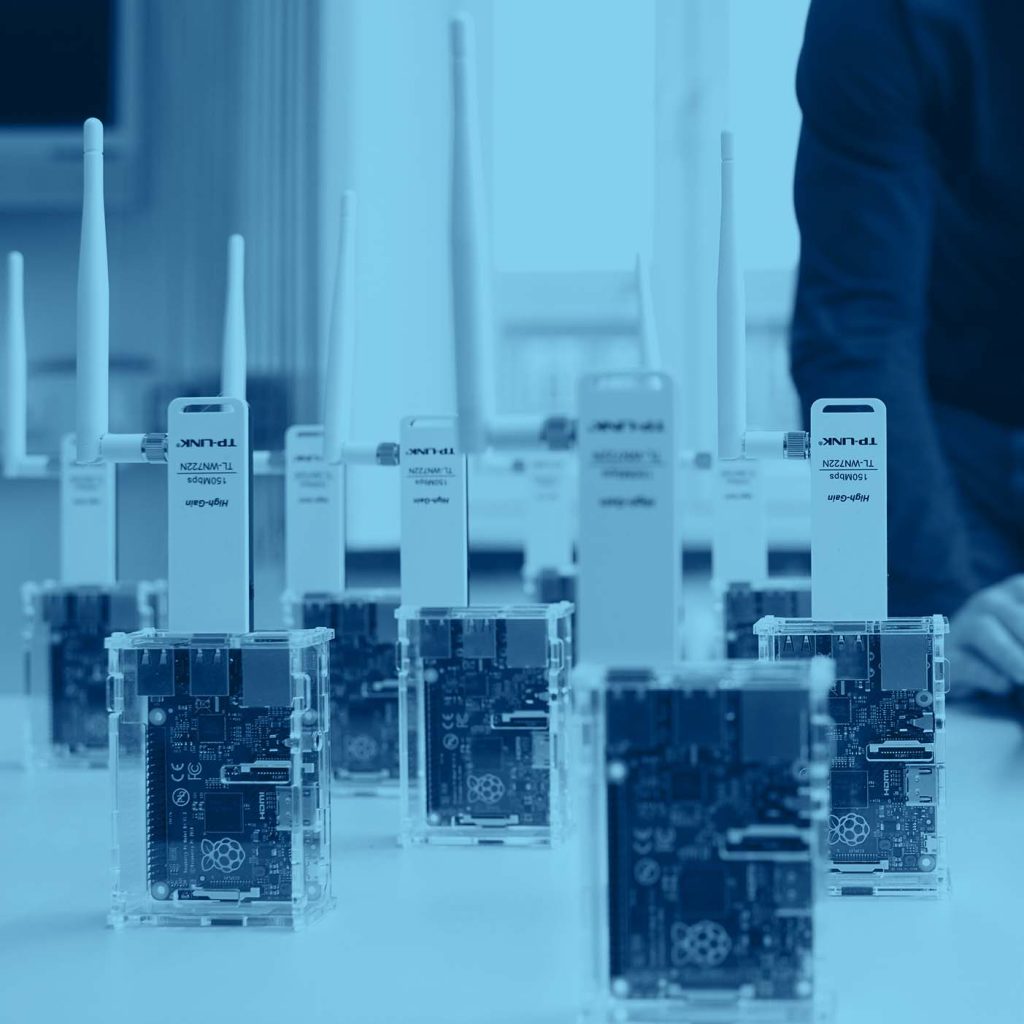
Wireless Mesh Networks (WMNs) enable devices with radio capabilities to communicate with each other directly. Such networks are based on opportunity instead of planning: devices detect the existing network on their own and connect to it without further configuration. Therefore, WMNs provide flexibility and are easy to extend.
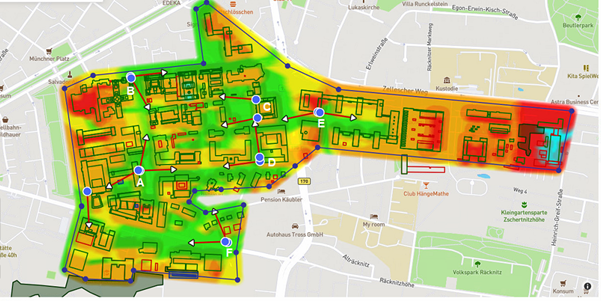
Our private 5G testbed is categorized into two main areas. The first is a university-wide 5G non-public network (NPN) that leverages commercially available hardware and software, ensuring continuous stability. This network facilitates application testing and interworking between 5G and other systems. Given its role as integral infrastructure, updates are solely installed by the central operator.
All components are interconnected to a central server hosting the 5G CN, GeniusCore.
The second category comprises lab testbeds within the ComNets Chair. These testbeds feature diverse hardware and software components to support individual 5G NPNs. They enable interoperability testing and measurements. Multiple legacy RAN systems are available, including Nokia and Huawei, which have been verified for interoperability with Open5GS (Open Source 5G-CN), GeniusCore, and OpenAirInterface CN (Open Source 5G-CN). Ericsson RAN is exclusively compatible with an Ericsson Core.
In addition to legacy RAN, O-RAN-based testbeds are also present. While legacy RAN is proprietary, O-RAN adheres to an open interface standard, promoting interoperability. O-RAN often operates fully virtualized on COTS hardware. Legacy RAN is disaggregated into three components: Radio Unit (RU), Distributed Unit (DU), and Central Unit (CU) with open interfaces between them. The testbed employs COTS servers to execute the CU and DU, thereby reducing costs. Multiple disaggregated O-RAN systems are integrated into the testbed. One is a commercial system from AirSpan, while the others are open-source projects: OpenAirInterface and srsRAN Project.
For integration testing, All-In-One Small Cells are available. These compact and easy-to-operate gNBs can be quickly deployed due to their simplified operation compared to legacy systems or disaggregated O-RAN. Vendors within the testbed include: AirSpan Airvelocity n78 (2T2R), T&W/Node-H small Cell n78 (2T2R), LiteOn FlexFI n78 (4T4R), and NI USRP N310.
This testbed is build with a Nokia Radio A Consicess Network with five sites. The sites have the following Equipment:
Site 1: 1 x Nokia ASIL Systemunit, 2 x Nokia ABIO Baseband; 2 x Nokia AEQE n78 Antenna (64T64R mmMIMO), 1 x Nokia AWEUC mmWave (n258) Antenna (2T2R)
Site 2: 1 x Nokia ASIL Systemunit, 1 x Nokia ABIO Baseband; 2 x Nokia AEQE n78 Antenna (64T64R mmMIMO)
Site 3 and 4: 1 x Nokia ASIL Systemunit, 1 x Nokia ABIO Baseband; 2 x Nokia AWHQF n78 Antenna (4T4R)
Site 5: 1 x ASOE System and Basebandunit, 2 x AZQJ n78 Antenna (8T8R)
They are all connected to a central server, where the 5G-Core, GeniusCore is hosted.
The second is the lab testbed at the ComNets Chair. Here we have different Hard- and Software Components to run a private 5G network, based on different release. Here interoperability tests and measurements can be performed.
There are several classical RAN Systems available. Nokia and Huawei have been tested and verified to be interoperable with the Open5GS (Open Source 5G-Core); the GeniusCore and the OpenAirInterace 5G-Core (Open Source 5G-Core). Ericsson RAN is only compatible to an Ericsson Core.
The following classical cellular systems are at the chair:
Nokia; ASIK Systemunit, ABIL Baseband, AZQH Radio, 2 x Indoor Airscale Hub and 8 x AWHQB Indoor Small Cell n78 (4T4T); 4 x AWHQK Indoor Small Cell n78 (4T4R)
ASIL Systemunit, ABIO Basebandunit,
Ericsson 5G NSA System: Baseband 6630; Dell Server for 4G and 5G Ericsson Core, Radio 2212, Radio 8823, Indoor Radio Uni, Ericsson Indoor Small Cell
Ericsson 5G SA System (Industry Connect): Network Controller, Dot 4479, IRU, Micro Radio 4408 n78 (4T4R)
Huawei: Basestation 5900; Radio RRU5836E n78 (4T4R); pRRU5935 3.7G n78 (4T4R); Indoor Radio Hub
Besides classical RAN there are also O-RAN Solutions available in the Testbed. While classical RAN is proprietary, O-RAN is mostly software based and supposed to be interoperable. The classical basestation gets disaggregated into three components: RU, DU, CU with open interfaces between them. The CU and DU are supposed to be executed on COTS servers; thus, reducing costs.
There are two disaggregated O-RAN Systems in the testbed. One is the commercial system from AirSpan, the other one is the open source project of OpenAirInterface.
For quick PoC there are All-In-One Small Cells available. They are a small, easy to operate gNB and can be set up quickly as they are less complex than classical systems or disaggregated O-RAN. Vendors in the Testbed are: AirSpan Airvelocity n78 (2T2R), T&W/Node-H small Cell n78 (2T2R), LiteOn FlexFI n78 (4T4R)
Zheng, Ruifeng; Zhou, Pengjie; Hofmann, Pit; Cabrera, Juan A.; Fitzek, Frank H. P.
System Modeling of Microfluidic Molecular Communication: A Markov Approach Proceedings Article
In: IEEE International Conference on Communications (ICC), Glasgow, United Kingdom, 2026.
@inproceedings{Zheng0526:System,

title = {System Modeling of Microfluidic Molecular Communication: A Markov Approach},

author = {Ruifeng Zheng and Pengjie Zhou and Pit Hofmann and Juan A. Cabrera and Frank H. P. Fitzek},

year  = {2026},

date = {2026-05-24},

urldate = {2026-05-01},

booktitle = {IEEE International Conference on Communications (ICC)},

address = {Glasgow, United Kingdom},

keywords = {},

pubstate = {published},

tppubtype = {inproceedings}

}
Xu, Zhihan; Cabrera, Juan A.; Fitzek, Frank H. P.
Function-Aligned Nonuniform Quantization Graph Coloring for Distributed Functional Compression Proceedings Article
In: IEEE International Conference on Communications: Communication Theory (ICC - CT), pp. 5.9, Glasgow, United Kingdom, 2026.
@inproceedings{Xu0526:Function,

title = {Function-Aligned Nonuniform Quantization Graph Coloring for Distributed Functional Compression},

author = {Zhihan Xu and Juan A. Cabrera and Frank H. P. Fitzek},

year  = {2026},

date = {2026-05-24},

urldate = {2026-05-24},

booktitle = {IEEE International Conference on Communications: Communication Theory (ICC - CT)},

pages = {5.9},

address = {Glasgow, United Kingdom},

keywords = {},

pubstate = {published},

tppubtype = {inproceedings}

}
Scheinert, Tobias; Danz, Lucas; Nazari, Hosein K.; Senk, Stefan; Liu, How-Hang; Seidel, Mauri; Nguyen, Giang T.; Fitzek, Frank H. P.
Time-Slot-Aware Transmission in 5G TDD for Edge-Controlled Robotics Proceedings Article
In: IEEE International Conference on Communications (ICC 2026), Workshop WS-05: 6G Connected Robotics, Glasgow, Scotland, UK, 2026.
@inproceedings{Scheinert2026:TSA5GTDD,

title = {Time-Slot-Aware Transmission in 5G TDD for Edge-Controlled Robotics},

author = {Tobias Scheinert and Lucas Danz and Hosein K. Nazari and Stefan Senk and How-Hang Liu and Mauri Seidel and Giang T. Nguyen and Frank H. P. Fitzek},

year  = {2026},

date = {2026-05-01},

urldate = {2026-05-01},

booktitle = {IEEE International Conference on Communications (ICC 2026), Workshop WS-05: 6G Connected Robotics},

address = {Glasgow, Scotland, UK},

keywords = {},

pubstate = {published},

tppubtype = {inproceedings}

}
Attawna, Mahdi; Hernandez-Gobertti, Fernando; Doan, Tung V.; Nguyen, Giang T.; Gomez-Barquero, David; Fitzek, Frank H. P.
SliceEdge: Edge-Based Network Slicing for Multimodal Tactile Internet Applications in 5G/6G Proceedings Article
In: IEEE International Conference on Communications (ICC 2026), Workshop WS04: 5th Workshop on Sustainable and Resilient Industrial Networks, Glasgow, Scotland, UK, 2026.
@inproceedings{Attawna2026:SliceEdge,

title = {SliceEdge: Edge-Based Network Slicing for Multimodal Tactile Internet Applications in 5G/6G},

author = {Mahdi Attawna and Fernando Hernandez-Gobertti and Tung V. Doan and Giang T. Nguyen and David Gomez-Barquero and Frank H. P. Fitzek},

year  = {2026},

date = {2026-05-01},

booktitle = {IEEE International Conference on Communications (ICC 2026), Workshop WS04: 5th Workshop on Sustainable and Resilient Industrial Networks},

address = {Glasgow, Scotland, UK},

keywords = {},

pubstate = {accepted},

tppubtype = {inproceedings}

}
Bayleyegn, Abebu Ademe; Ghadimi, Milad; Habibie, Muhammad Idham; Bassoli, Riccardo; Fitzek, Frank H. P.
Faking Bell Violations with Classical Light and Side-Channel Attacks Proceedings Article
In: IEEE INFOCOM WKSHPS: QuNAP 2026: Quantum Networked Applications and Protocols (INFOCOM QuNAP 2026), pp. 5.84, Tokyo, Japan, 2026.
@inproceedings{Bayl2605:Faking,

title = {Faking Bell Violations with Classical Light and Side-Channel Attacks},

author = {Abebu Ademe Bayleyegn and Milad Ghadimi and Muhammad Idham Habibie and Riccardo Bassoli and Frank H. P. Fitzek},

year  = {2026},

date = {2026-05-01},

booktitle = {IEEE INFOCOM WKSHPS: QuNAP 2026: Quantum Networked Applications and Protocols (INFOCOM QuNAP 2026)},

pages = {5.84},

address = {Tokyo, Japan},

keywords = {},

pubstate = {published},

tppubtype = {inproceedings}

}
Tunc, Hilal Sultan Duranoglu; Halder, Joy; Habibie, Muhammad Idham; Arar, Bassem; Bassoli, Riccardo; Fettweis, Gerhard P.; Fitzek, Frank H. P.
Routing in Bufferless Quantum Networks Proceedings Article
In: IEEE INFOCOM WKSHPS: QuNAP 2026: Quantum Networked Applications and Protocols (INFOCOM QuNAP 2026), pp. 5.97, Tokyo, Japan, 2026.
@inproceedings{Dura2605:Routing,

title = {Routing in Bufferless Quantum Networks},

author = {Hilal Sultan Duranoglu Tunc and Joy Halder and Muhammad Idham Habibie and Bassem Arar and Riccardo Bassoli and Gerhard P. Fettweis and Frank H. P. Fitzek},

year  = {2026},

date = {2026-05-01},

booktitle = {IEEE INFOCOM WKSHPS: QuNAP 2026: Quantum Networked Applications and

Protocols (INFOCOM QuNAP 2026)},

pages = {5.97},

address = {Tokyo, Japan},

keywords = {},

pubstate = {published},

tppubtype = {inproceedings}

}
Raman, Vignesh; Bassoli, Riccardo; Fitzek, Frank H. P.
Quantum Electromagnetic Curvature Resilience: An Information-Geometry Metric for Wireless Quantum Networks Proceedings Article
In: 20th European Conference on Antennas and Propagation (EuCAP), pp. 5, Dublin, Ireland, 2026.
@inproceedings{Rama2026:Quantum,

title = {Quantum Electromagnetic Curvature Resilience: An Information-Geometry Metric for Wireless Quantum Networks},

author = {Vignesh Raman and Riccardo Bassoli and Frank H. P. Fitzek},

year  = {2026},

date = {2026-04-19},

urldate = {2026-04-19},

booktitle = {20th European Conference on Antennas and Propagation (EuCAP)},

pages = {5},

address = {Dublin, Ireland},

keywords = {},

pubstate = {published},

tppubtype = {inproceedings}

}
Lehmann, Manuel Schappacher Dominik Welte Christopher; Fitzek, Frank H. P.
Demonstration of Device Discovery on Device-Side 5G-TSN Bridge Translator Proceedings Article
In: International IEEE Conference on Factory Communication Systems (WFCS 2026), Offenburg, Germany, 2026.
@inproceedings{Lehmann2604:DemoDeviceDiscovery,

title = {Demonstration of Device Discovery on Device-Side 5G-TSN Bridge Translator},

author = {Manuel Schappacher Dominik Welte Christopher Lehmann and Frank H. P. Fitzek},

year  = {2026},

date = {2026-04-01},

booktitle = {International IEEE Conference on Factory Communication Systems (WFCS 2026)},

address = {Offenburg, Germany},

keywords = {},

pubstate = {published},

tppubtype = {inproceedings}

}
Schappacher, Tobias Scheinert Dominik Welte Manuel; Fitzek, Frank H. P.
Demonstration of End-to-End Time Synchronization over 5G-TSN Proceedings Article
In: International IEEE Conference on Factory Communication Systems (WFCS 2026), Offenburg, Germany, 2026.
@inproceedings{xGAloe2026:DE2ETSO5GTSN,

title = {Demonstration of End-to-End Time Synchronization over 5G-TSN},

author = {Tobias Scheinert Dominik Welte Manuel Schappacher and Frank H. P. Fitzek},

year  = {2026},

date = {2026-04-01},

booktitle = {International IEEE Conference on Factory Communication Systems (WFCS 2026)},

address = {Offenburg, Germany},

keywords = {},

pubstate = {accepted},

tppubtype = {inproceedings}

}
Yilmaz, Isikcan; Schulz, Jonas; Cabrera, Juan A.; Seeling, Patrick; Fitzek, Frank H. P.
Network Coding Assisted In-Network Caching Implementation for Multi-Hop IoT Networks Proceedings Article
In: 2026 Global Information Infrastructure and Networking Symposium (GIIS) (GIIS'26), pp. 4.56, Nanjing, China, 2026.
@inproceedings{Yilm2604:Network,

title = {Network Coding Assisted In-Network Caching Implementation for Multi-Hop

IoT Networks},

author = {Isikcan Yilmaz and Jonas Schulz and Juan A. Cabrera and Patrick Seeling and Frank H. P. Fitzek},

year  = {2026},

date = {2026-04-01},

booktitle = {2026 Global Information Infrastructure and Networking Symposium (GIIS)

(GIIS'26)},

pages = {4.56},

address = {Nanjing, China},

keywords = {},

pubstate = {published},

tppubtype = {inproceedings}

}
Patrick Enenche; Osel Lhamo; Tung V. Doan; Mahdi Attawna; Giang T. Nguyen; Dongho You; Frank H. P. Fitzek
In: IEEE International Conference on Communications (ICC), Montreal, Canada, 2025.
Patrick Enenche; Osel Lhamo; Tung V. Doan; Mahdi Attawna; Giang T. Nguyen; Dongho You; Frank H. P. Fitzek
In: IEEE International Conference on Communications (ICC), Montreal, Canada, 2025.
Patrick Enenche; Osel Lhamo; Tung V. Doan; Mahdi Attawna; Giang T. Nguyen; Dongho You; Frank H. P. Fitzek
In: IEEE International Conference on Communications (ICC), Montreal, Canada, 2025.
Patrick Enenche; Osel Lhamo; Tung V. Doan; Mahdi Attawna; Giang T. Nguyen; Dongho You; Frank H. P. Fitzek
In: IEEE International Conference on Communications (ICC), Montreal, Canada, 2025.

Interested students may contact us directly or write an email to Dr.-Ing. Rico Radeke or the respective supervisors.