

Lectures
Our teaching covers communication networks, software engineering, queing theory, and statistics, combining theory and practice through problem-based learning.
Software Engineering Grundlagen
After completing the module, students have competencies and practical skills in dealing with various programming languages and programming environments.
The module focuses on the structure and programming of computers with Python and Assembler. This includes information representation, basic Boolean circuits, computer architecture, algorithms and their complexity analysis, i.e. Big O notation.
At a glance
Module Number: EuI-ET-C-SwEgG
Type: compulsory course
Semester: 1th Semester ET
Term: annually in winter semester
Language: German (material in English)
Extent: 2/1/1
Exam: written, 120 min
Credits: 5
Lecturers and Teaching Assistants




16/10/2025
9:20 – 10:50
L2 – Basics: variables, lists, sets, if, loops, dictionary, math
Prof. Frank Fitzek
22/10/2025
13:00 – 14:30
E1 – Basics: flow chart, variables, math
Dr. Stanislav Mudriievskyi
29/10/2025
13:00 – 14:30
E2 – Input, output, if statement, boolean logic
Fatima Rani, Dr. Stanislav Mudriievskyi, Nico vom Hofe
29/10/2025
14:50 – 16:20
L5 – Introduction to Raspberry Pi Pico: blink, button
Dr. Stanislav Mudriievskyi
05/11/2025
13:00 – 14:30
E3 – Loops: while, for; arrays (lists)
Fatima Rani, Dr. Stanislav Mudriievskyi, Nico vom Hofe
06/11/2025
9:20 – 10:50
L8 – Raspberry Pi Pico: seven-segment display
Dr. Stanislav Mudriievskyi
12/11/2025
13:00 – 14:30
E4 – Functions, Raspberry Pi Pico: seven-segment display
Fatima Rani, Dr. Stanislav Mudriievskyi, Nico vom Hofe
12/11/2025
14:50 – 16:20
L9 – Practical examples in MicroPython for Raspberry Pi Pico
Dr. Roland Schingnitz
13/11/2025
9:20 – 10:50
L10 – Raspberry Pi Pico: ADC, UART, PWM
Dr. Stanislav Mudriievskyi
19/11/2025
No lecture – Public holiday
20/11/2025
No lecture – Project week
26/11/2025
13:00 – 14:30
E5 – Q&A to lab1
Fatima Rani, Dr. Stanislav Mudriievskyi, Nico vom Hofe
26/11/2025
14:50 – 16:20
L11 – Raspberry Pi Pico: PWM, interrupts, multi-core
Dr. Stanislav Mudriievskyi
03/12/2025
13:00 – 14:30
E6 – Logic gates
Fatima Rani, Dr. Stanislav Mudriievskyi, Nico vom Hofe
10/12/2025
13:00 – 14:30
E7 – Read from / write to file
Fatima Rani, Dr. Stanislav Mudriievskyi, Nico vom Hofe
07/01/2025
13:00 – 14:30
E8 – Q&A to lab2, lab3
Fatima Rani, Dr. Stanislav Mudriievskyi, Nico vom Hofe
21/01/2026
14:50 – 16:20
L15 – Consultation, trial exam tasks, Q&A
Prof. Frank Fitzek, Dr. Stanislav Mudriievskyi
Software Engineering Vertiefung
After completing the module, students will be able to apply their programming skills to an embedded system and select different programming environments based on their complexity and level of application.
Contents of the module are embedded systems such as Raspberry Pi Pico and the efficient and portable programming of data structures and algorithms in a typed procedural language such as C as well as the comparison with other languages such as Assembler or MicroPython. The module also includes object-
oriented programming languages.
At a glance
Module Number: EuI-ET-C-SwEgV
Type: compulsory course
Semester: 2th Semester ET
Term: annually in summer semester
Language: German (material in English)
Extent: 2/1/1
Exam:
Credits: 5
Lecturers and Teaching Assistants
15/04/2026
16:40 – 18:10
E1 – Software installation
Dr. Stanislav Mudrievski, Fatima Rani, Hristina Radak, Josef Gudnason, Cyrill Burth, Sifat Rezwan
20/04/2026
14:50 – 16:20
L2 – Information representation, numeral systems
Dr. Stanislav Mudrievski
22/04/2026
16:40 – 18:10
E2 – Information representation, numeral systems
Dr. Stanislav Mudrievski, Fatima Rani, Hristina Radak, Josef Gudnason, Cyrill Burth, Sifat Rezwan
27/04/2026
14:50 – 16:20
L3 – Information representation 2, fixed-point, floating-point
Dr. Stanislav Mudrievski
29/04/2026
16:40 – 18:10
E3 – Information representation 2, fixed-point, floating-point, C basics
Dr. Stanislav Mudrievski, Fatima Rani, Hristina Radak, Josef Gudnason, Cyrill Burth, Sifat Rezwan
13/05/2026
16:40 – 18:10
E4 – Generic C: functions, header, arrays
Dr. Stanislav Mudrievski, Fatima Rani, Hristina Radak, Josef Gudnason, Cyrill Burth, Sifat Rezwan
18/05/2026
14:50 – 16:20
L6 – C for Raspberry Pi Pico: ADC, memory, pointers
Dr. Stanislav Mudrievski
20/05/2026
16:40 – 18:10
E5 – C for Raspberry Pi Pico: ADC, memory, pointers
Dr. Stanislav Mudrievski, Fatima Rani, Hristina Radak, Josef Gudnason, Cyrill Burth, Sifat Rezwan
25/05/2026
No lecture – Public holiday
27/05/2026
No exercise – Lecture free week
08/06/2026
14:50 – 16:20
L8 – Memory allocation and access, debugging
Dr. Stanislav Mudrievski
10/06/2026
16:40 – 18:10
E7 – Memory allocation and access, debugging
Dr. Stanislav Mudrievski, Hristina Radak, Josef Gudnason, Cyrill Burth, Sifat Rezwan
24/06/2026
16:40 – 18:10
E8 – Consultation
Dr. Stanislav Mudrievski, Hristina Radak, Josef Gudnason, Cyrill Burth, Sifat Rezwan
Software Engineering Vertiefung
After completing the module, students will be able to apply their programming skills to an embedded system and select different programming environments based on their complexity and level of application.
Contents of the module are embedded systems such as Raspberry Pi Pico and the efficient and portable programming of data structures and algorithms in a typed procedural language such as C as well as the comparison with other languages such as Assembler or MicroPython. The module also includes object-
oriented programming languages.
At a glance
Module Number: EuI-ET-C-SwEgV
Type: compulsory course
Semester: 2th Semester ET
Term: annually in summer semester
Language: German (material in English)
Extent: 2/1/1
Exam:
Credits: 5
Lecturers and Teaching Assistants
15/04/2026
16:40 – 18:10
E1 – Software installation
Dr. Stanislav Mudrievski, Fatima Rani, Hristina Radak, Josef Gudnason, Cyrill Burth, Sifat Rezwan
20/04/2026
14:50 – 16:20
L2 – Information representation, numeral systems
Dr. Stanislav Mudrievski
22/04/2026
16:40 – 18:10
E2 – Information representation, numeral systems
Dr. Stanislav Mudrievski, Fatima Rani, Hristina Radak, Josef Gudnason, Cyrill Burth, Sifat Rezwan
27/04/2026
14:50 – 16:20
L3 – Information representation 2, fixed-point, floating-point
Dr. Stanislav Mudrievski
29/04/2026
16:40 – 18:10
E3 – Information representation 2, fixed-point, floating-point, C basics
Dr. Stanislav Mudrievski, Fatima Rani, Hristina Radak, Josef Gudnason, Cyrill Burth, Sifat Rezwan
13/05/2026
16:40 – 18:10
E4 – Generic C: functions, header, arrays
Dr. Stanislav Mudrievski, Fatima Rani, Hristina Radak, Josef Gudnason, Cyrill Burth, Sifat Rezwan
18/05/2026
14:50 – 16:20
L6 – C for Raspberry Pi Pico: ADC, memory, pointers
Dr. Stanislav Mudrievski
20/05/2026
16:40 – 18:10
E5 – C for Raspberry Pi Pico: ADC, memory, pointers
Dr. Stanislav Mudrievski, Fatima Rani, Hristina Radak, Josef Gudnason, Cyrill Burth, Sifat Rezwan
25/05/2026
No lecture – Public holiday
27/05/2026
No exercise – Lecture free week
08/06/2026
14:50 – 16:20
L8 – Memory allocation and access, debugging
Dr. Stanislav Mudrievski
10/06/2026
16:40 – 18:10
E7 – Memory allocation and access, debugging
Dr. Stanislav Mudrievski, Hristina Radak, Josef Gudnason, Cyrill Burth, Sifat Rezwan
24/06/2026
16:40 – 18:10
E8 – Consultation
Dr. Stanislav Mudrievski, Hristina Radak, Josef Gudnason, Cyrill Burth, Sifat Rezwan
Hauptseminar Kommunikationstechnik
This seminar series shall help students to work, research, document and present on a scientific basis.
The Hauptseminar is preparing for Studien- /Master- and Diplomtheses.
Course materials and further information are to be found at the OPAL-Website of the course.
At a glance
Module Number: ET-12 10 02
Type: compulsory course
Semester: 6th Semester ET
Term: annually in summer semester
Language: German
Extent: 0/2/0
Exam: project work
Credits: 4
Lecturers and Teaching Assistants

22.04.2026
11:10
Seminar 1 – Scientific Work Ethics (Plagiarism, Citing, Referencing)
Dr. Rico Radeke
29.04.2026
11:10
Lecture 1 – Sprachtechnologie und Kognitive Systeme
João Vítor Possamai de Menezes // Prof. Peter Birkholz
08.07.2026
11:10
L7 – Radio Frequency and Photonics Engineering
Prof. Dirk Plettemeier // Prof. Kambiz Jamshidi
at least 3 days before project presentations
Project report to be turned in
online and paper
at least 3 days before poster session (before Aug 19th)
Exam Part 1 – Project presentation and discusssion
at responsible chair
Projects
The students work in small groups on a research topic affiliated with a chair of the Barkhausenzentrum. The results have to be combined and documented in a project thesis. Topics will be distributed in the first seminars. Project descriptions and contact information of those will be available at the OPAL-Website.
The students have to present the research results on a final meeting.
Communication Networks 1 / Kommunikationsnetze 1
Communication Networks 1 introduces the fundamental principles of communication networks, starting from the communication link and building up to multiple access, graph-based networks, Internet architecture, cooperative wireless systems, and network coding. The course combines foundational concepts from communication theory and networking with selected advanced topics that prepare students for Communication Networks 2 and 3.
At a glance
Module Number: ET-12 10 04, RES-WK-45
Type: compulsory course
Semester: 6th Semester ET/IT
Term: annually in summer semester
Language: German (material in English)
Extent: 2/2/0
Exam: written, 150 min
Credits: 4
Schedule: Tuesday 2.DS, Thursday 3.DS
Lecturers and Teaching Assistants






Tue, 2026-04-14
9:20 – 10:50
L1 – Introduction to the Chair and Course Overview
Lecturer: Prof. Frank Fitzek – Introduction to the chair; research areas; major projects; student opportunities; overview of CN1/CN2/CN3; motivation and roadmap of the course
BAR/0106/H
Thu, 2026-04-16
11:10 – 12:40
L2 – History of Communication Networks
Lecturer: Prof. Frank Fitzek – Early relay systems; Persian communication systems; Chappe telegraph; telegraphy; telephone networks; hierarchy; switching; addressing
BAR/0I88/U
Tue, 2026-04-21
9:20-10:50
E1 – Exercise Introduction
Teaching Assistant: Stefan – Organizational topics, Python environment, ISO/OSI Layer Model
BAR/0106/H
Thu, 2026-04-23
11:10 – 12:40
L3 – Shannon’s Communication Model and Capacity
Lecturer: Prof. Frank Fitzek – Information source; transmitter; channel; receiver; destination; noisy channels; conceptual meaning of Shannon capacity; molecular channel example; ISI; multipath
BAR/0I88/U
Tue, 2026-04-28
9:20 – 10:50
L4 – Source Coding, Channel Coding and Reliable Transmission
Lecturer: Prof. Frank Fitzek – Coding motivation; Huffman coding; Hamming coding; compression; redundancy; reliability-efficiency trade-offs; introduction to retransmission concepts
BAR/0106/H
Thu, 2026-04-30
11:10 – 12:40
E2 – Source Coding, Channel Coding and Reliable Transmission
Teaching Assistant: Pit
BAR/0I88/U
Tue, 2026-05-05
9:20 – 10:50
L5 – Multiple Access: From ALOHA to Scheduled Access
Lecturer: Prof. Frank Fitzek – ALOHA; slotted ALOHA; collisions; throughput; random access; TDMA; FDMA; CDMA; OFDMA; backoff; Kleinrock
BAR/0106/H
Thu, 2026-05-07
11:10 – 12:40
L6 – Ethernet, Wi-Fi, and Wireless Access Procedures
Lecturer: Prof. Frank Fitzek – Ethernet; CSMA/CD; Wi-Fi; CSMA/CA; RTS/CTS/DATA/ACK; timers; hidden and exposed terminal problems; contention and backoff
BAR/0I88/U
Tue, 2026-05-12
9:20 – 10:50
L7 – Graphs, Flows and Network Capacity
Lecturer: Prof. Frank Fitzek – Graph models of networks; nodes; edges; paths; connectivity; bottlenecks; cuts; max-flow min-cut; mesh network capacity
BAR/0106/H
Thu, 2026-05-14
11:10 – 12:40
Ascension day
No lecture, no exercise
BAR/0I88/U
Tue, 2026-05-19
9:20 – 10:50
E3 – Multiple Access: From ALOHA to Scheduled Access
Teaching Assistant: Tobias
BAR/0106/H
Thu, 2026-05-21
11:10 – 12:40
E4 – Ethernet, Wi-Fi, and Wireless Access Procedures
Teaching Assistant: Christian
BAR/0I88/U
Tue, 2026-05-26
9:20 – 10:50
Pentecost
No lecture, no exercise
BAR/0106/H
Thu, 2026-05-28
11:10 – 12:40
Pentecost
No lecture, no exercise
BAR/0I88/U
Tue, 2026-06-02
9:20 – 10:50
L8 – Routing and Path Algorithms
Lecturer: Prof. Frank Fitzek – Routing as path selection; shortest-path problems; Dijkstra; Floyd-Warshall; Ford-Fulkerson; shortest path vs. maximum flow
BAR/0106/H
Thu, 2026-06-04
11:10 – 12:40
L9 – Internet Architecture: Layering, Services, and Packet Switching
Lecturer: Prof. Frank Fitzek – Layering; services and protocols; OSI model; TCP/IP model; encapsulation; decapsulation; packet switching; circuit switching; end-to-end principle
BAR/0I88/U
Tue, 2026-06-09
9:20 – 10:50
L10 – The Network Layer: IP, Addressing, and Forwarding
Lecturer: Tobias – Internetworking; datagram communication; best-effort delivery; IPv4/IPv6 overview; addressing; subnetting; forwarding; routing tables; next-hop forwarding
BAR/0106/H
Thu, 2026-06-11
11:10 – 12:40
E5 – Graphs, Flows and Network Capacity, Routing and Path Algorithms
Teaching Assistant: Tobias
BAR/0I88/U
Tue, 2026-06-16
9:20 – 10:50
E6 – The Network Layer: IP, Addressing, and Forwarding
Teaching Assistant: Tobias
BAR/0106/H
Thu, 2026-06-18
11:10 – 12:40
H1 – Hands-on: Network Tools
Teaching Assistant: Stefan – Packet Generation (with Python), Wireshark, etc.
BAR/0I88/U
Tue, 2026-06-23
9:20 – 10:50
E7 – The Transport Layer: UDP, TCP, and Congestion Control
Teaching Assistant: Peter
BAR/0106/H
Thu, 2026-06-25
11:10 – 12:40
H2 – Hands-on: WiFi Security
Teaching Assistant: Stefan – Security aspects to consider for developing modern wireless systems by example of WPA2
BAR/0I88/U
Tue, 2026-06-30
9:20 – 10:50
E8 – Hands-on: End-to-End Connection
Teaching Assistant: Mauri – How does the Internet work?
BAR/0106/H
Thu, 2026-07-02
11:10 – 12:40
H3 – Hands-on: Applications
Teaching Assistant: Christian – What is your web browser doing?
BAR/0I88/U
Tue, 2026-07-07
9:20 – 10:50
L12 – Cooperative Wireless Networks and Wireless Mesh Networks
Lecturer: Prof. Frank Fitzek – Wireless mesh networks; relaying; cooperation under common objectives; robustness and coverage gains; cooperative diversity; egoistic users; battery constraints; strategic aspects
BAR/0106/H
Thu, 2026-07-09
11:10 – 12:40
E9 – Cooperative Wireless Networks and Wireless Mesh Networks
Teaching Assistant: Peter
BAR/0I88/U
Tue, 2026-07-14
9:20 – 10:50
L13 – Network Coding I: Motivation and Fundamental Examples
Lecturer: Prof. Frank Fitzek – Routing versus coding; butterfly network; coding at intermediate nodes; multicast; relation to max-flow min-cut; communication gains through coding
BAR/0106/H
Thu, 2026-07-16
11:10 – 12:40
L14 – Network Coding II: Capacity, Algebra, and In-Network Computing
Lecturer: Prof. Frank Fitzek – Linear network coding; finite fields; multicast capacity; distributed encoding/decoding; in-network processing; communication and computation
BAR/0I88/U
Tue, 2026-07-21
9:20 – 10:50
E10 – Network Coding (English)
Teaching Assistant: Hosein
BAR/0106/H
Thu, 2026-07-23
11:10 – 12:40
E11 – The Fifth Generation of Cellular Networks (5G)
Teaching Assistant: Mauri
BAR/0I88/U
t.b.d.
Exam Consultation
Your questions!
t.b.d.
Mo, 2026-08-10
13:00 – 15:30
Exam
written, 150min
t.b.d.

Contact Person
Please contact Stefan for general questions and problems, and for specific issues the corresponding teaching assistant.
Communication Networks 2 / Kommunikationsnetze 2
In this course, we cover hot topics of communication networks, including but not limited to:
- Computation in Future Communication Networks and Tactile Internet
- Network Slicing
- Mobile Edge Cloud (MEC)
- Software-defined Networking (SDN)
- Network Function Virtualization (NFV)
- Time-Sensitive Networking (TSN)
- 5G Architecture
- OpenAirInterface (OAI) Setup
- Hands-on Exercises: Mininet, ComNetsEmu, Docker, Network Slicing, Mobile Edge Cloud, 5G-Core, and 5G-RAN
At a glance
Part of Module:
Communication Networks, Advanced I
Module Number: ET-12 10 05
Type: elective
Semester: 8
Term: annually in summer semester
Language: English
Extent: 2/1/0
Exam: tbd
Lecturers and Teaching Assistants





20/04/2026
14:50
L2 – No lecture (Cancelled)
18/05/2026
No lecture
Bank holiday
21/05/2026
No exercise
Bank holiday
25/05/2026
No exercise
Bank holiday
15/06/2026
14:50
L8 – General, High-Level Introduction into 5G Architecture, 5G Protocoll and how 5G works
02/07/2026
13:00
E5 – RAN I: Architecture; Wireless Channel, Main KPIs, Configuration and Influence, Iperf/Measurements, Interpretation

Contact Person
Please contact Osel Lhamo for general questions and problems, and for specific issues the corresponding teaching assistant.
Textbooks
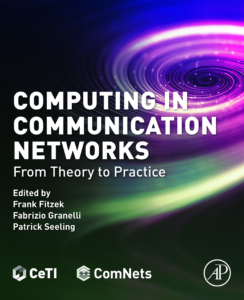
An introduction to the book and related slides for each chapter can be found on our website. We will distribute the corresponding chapters of the book in the course.
Related Publications
2019
Schmoll, Robert-Steve; Fischer, Tobias; Salah, Hani; Fitzek, Frank H. P.
Comparing and Evaluating Application-specific Boot Times of Virtualized Instances Proceedings Article
In: IEEE 5G World Forum, Dresden, Germany, 2019.
@inproceedings{Schmoll2019,

title = {Comparing and Evaluating Application-specific Boot Times of Virtualized Instances},

author = {Robert-Steve Schmoll and Tobias Fischer and Hani Salah and Frank H. P. Fitzek},

year  = {2019},

date = {2019-10-01},

booktitle = {IEEE 5G World Forum},

address = {Dresden, Germany},

keywords = {},

pubstate = {published},

tppubtype = {inproceedings}

}
Doan, Tung V.; Nguyen, Giang T.; Salah, Hani; Pandi, Sreekrishna; Jarschel, Michael; Pries, Rastin; Fitzek, Frank H. P.
Containers vs Virtual Machines: Choosing the Right Virtualization Technology for Mobile Edge Cloud Proceedings Article
In: IEEE 5G World Forum, Dresden, Germany, 2019.
@inproceedings{Doan2019b,

title = {Containers vs Virtual Machines: Choosing the Right Virtualization Technology for Mobile Edge Cloud},

author = {Tung V. Doan and Giang T. Nguyen and Hani Salah and Sreekrishna Pandi and Michael Jarschel and Rastin Pries and Frank H. P. Fitzek},

year  = {2019},

date = {2019-10-01},

booktitle = {IEEE 5G World Forum},

address = {Dresden, Germany},

keywords = {},

pubstate = {published},

tppubtype = {inproceedings}

}
You, Dongho; Doan, Tung V.; Torre, Roberto; Mehrabi, Mahshid; Kropp, Alexander; Salah, Hani; Nguyen, Vu; Nguyen, Giang T.; Fitzek, Frank H. P.
Fog Computing as an Enabler for Immersive Media: Service Scenarios and Research Opportunities Journal Article
In: IEEE Access, 2019.
@article{You2019b,

title = {Fog Computing as an Enabler for Immersive Media: Service Scenarios and Research Opportunities},

author = {Dongho You and Tung V. Doan and Roberto Torre and Mahshid Mehrabi and Alexander Kropp and Hani Salah and Vu Nguyen and Giang T. Nguyen and Frank H. P. Fitzek},

year  = {2019},

date = {2019-08-01},

journal = {IEEE Access},

keywords = {},

pubstate = {published},

tppubtype = {article}

}
Doan, Tung V.; Kropp, Alexander; Nguyen, Giang T.; Salah, Hani; Fitzek, Frank H. P.
Reusing Sub-chains of Network Functions to Support MEC Services Proceedings Article
In: IEEE ISCC, Barcelona, Spain, 2019.
@inproceedings{iscc20191,

title = {Reusing Sub-chains of Network Functions to Support MEC Services},

author = {Tung V. Doan and Alexander Kropp and Giang T. Nguyen and Hani Salah and Frank H. P. Fitzek},

year  = {2019},

date = {2019-06-30},

booktitle = {IEEE ISCC},

address = {Barcelona, Spain},

keywords = {},

pubstate = {published},

tppubtype = {inproceedings}

}
Rischke, Justus; Gabriel, Frank; Pandi, Sreekrishna; Nguyen, Giang T.; Salah, Hani; Fitzek, Frank H. P.
Improving Communication Reliability Efficiently: Adaptive Redundancy for RLNC in SDN Proceedings Article
In: 2019 IEEE Conference on Network Softwarization (NetSoft) (NetSoft 2019), Paris, France, 2019.
@inproceedings{Risc1906:Improving,

title = {Improving Communication Reliability Efficiently: Adaptive Redundancy for RLNC in SDN},

author = {Justus Rischke and Frank Gabriel and Sreekrishna Pandi and Giang T. Nguyen and Hani Salah and Frank H. P. Fitzek},

year  = {2019},

date = {2019-06-01},

booktitle = {2019 IEEE Conference on Network Softwarization (NetSoft) (NetSoft 2019)},

address = {Paris, France},

keywords = {},

pubstate = {published},

tppubtype = {inproceedings}

}
Xiang, Zuo; Gabriel, Frank; Urbano, Elena; Nguyen, Giang T.; Reisslein, Martin; Fitzek, Frank H. P.
Reducing Latency in Virtual Machines Enabling Tactile Internet for Human Machine Co-working Journal Article
In: IEEE Journal on Selected Areas in Communications, vol. 37, no. 5, pp. 1098-1116, 2019, ISSN: 0733-8716.
@article{Xian1803:Reducing,

title = {Reducing Latency in Virtual Machines Enabling Tactile Internet for Human Machine Co-working},

author = {Zuo Xiang and Frank Gabriel and Elena Urbano and Giang T. Nguyen and Martin Reisslein and Frank H. P. Fitzek},

doi = {10.1109/JSAC.2019.2906788},

issn = {0733-8716},

year  = {2019},

date = {2019-05-01},

urldate = {2019-05-01},

journal = {IEEE Journal on Selected Areas in Communications},

volume = {37},

number = {5},

pages = {1098-1116},

address = {, USA},

abstract = {Software Defined Networking (SDN) and Network Function Virtualization (NFV) processed in Multi-access Edge Computing (MEC) cloud systems have been proposed as critical paradigms for achieving the low latency requirements of the tactile Internet. While virtual network functions (VNFs) allow greater flexibility compared to hardware based solutions, the VNF abstraction also introduces additional packet processing delays. In this paper, we investigate the practical feasibility of NFV with respect to the tactile Internet latency requirements. We develop, implement, and evaluate Chain bAsed Low latency VNF ImplemeNtation (CALVIN), a low-latency management framework for distributed Service Function Chains (SFCs). CALVIN classifies VNFs into elementary, basic, and advanced VNFs. CALVIN implements elementary and basic VNFs in the kernel space, while advanced VNFs are implemented in the user space. Throughout, CALVIN employs a distributed mapping with one VNF per Virtual Machine (VM) in a MEC system. Moreover, CALVIN avoids the metadata structure processing and batch processing of packets in the conventional Linux networking stack so as to achieve short per-packet latencies. Our rigorous measurements on off-the-shelf conventional networking and computing hardware demonstrate that CALVIN achieves round-trip times from a MEC ingress point via an elementary forwarding VNF and a MEC server to a MEC egress point on the order of 0.32~ms. Our measurements also indicate that MEC network coding and encryption are feasible for small 256 byte packets with an MEC latency budget of .35~ms; whereas, large 1400 byte packets can complete the network coding, but not the encryption within the 0.35~ms.},

keywords = {},

pubstate = {published},

tppubtype = {article}

}
Practical Implementations of Network Coding/Netzwerkkodierung in Theorie und Praxis
Please note that this course will not be offered this semester. Nevertheless, if you are interested in the topic, please contact us.
This course introduces the students to the challenges and approaches of the state-of-the-art implementations of network coding. The course is taught not just through lectures but also with hands-on exercises using the Kodo software library. Kodo is available as a C++ and Python library and web tool. Therefore, students with different programming preferences will be able to approach it.
The initial lectures refresh the knowledge of the students of the theoretical background of network coding, e.g., the min-cut max-flow of a network, inter-flow network coding, and intra-flow Random Linear Network Coding (RLNC). The student is then introduced to the state-of-the-art software library Kodo and the advanced implementations of network coding such as systematic, sparse, tunable sparse, sliding window, etc. The course also covers the benefits of network coding in distributed storage applications. By the end of the course, the student will be introduced to advanced applications of network coding, e.g., Coded TCP, MORE, FULCRUM.
The exercises will teach the students how to use sockets in python as well as the python bindings of the Kodo software library for implementing unicast and broadcast communication applications.
You can apply for a research license for PyErasure. Specify that you are a student from the network coding course at the TUD. You will need a Github account where the source code is hosted.
At a glance
Module Number: ET-12 10 21
Type: elective course
Semester: 8th Semester ET
Term: annually in summer semester
Language: English
Extent: 2/1/0
Credits: 7
Lecturers and Teaching Assistants
Please note that this course will not be offered this semester. Nevertheless, if you are interested in the topic, please contact us.
Further Material
The Math Prodigy Who Died in a Duel
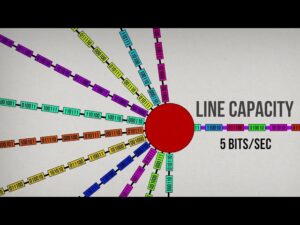
How Internet Communication Works: Network Coding – Art of the Problem
- Everything you ever wanted to know about UDP sockets but were afraid to ask
- Codebreakers – Auf der Jagd nach Hitlers Geheimcode
- QUIC is a transport protocol originally designed, implemented and deployed by Google that is being standardized at the IETF, and it is used nowadays by many servers in the world and supported by several web browsers. Its first stable specification will bring the same functionality as TCP+TLS+HTTP/2. In this article, the authors add Forward Error Correction (FEC) codes to the protocol and show their results.
- Médard, Muriel, et al. “Network coding mythbusting why it is not about butterflies anymore.” IEEE Communications Magazine 52.7 (2014): 177-183.
- Ahlswede, Rudolf, et al. “Network information flow.” Information Theory, IEEE Transactions on 46.4 (2000): 1204-1216.
- Koetter, Ralf, and Muriel Médard. “An algebraic approach to network coding.”IEEE/ACM Transactions on Networking (TON) 11.5 (2003): 782-795.

Contact Person
Please contact Juan Cabrera for general questions and problems.
Cooperative Communication Systems/Kooperative Kommunikation
Please note that this course will not be offered this semester. Nevertheless, if you are interested in the topic, please contact us.
This course aims at giving the students a complete overview of cooperation among modern communication networks that aid in achieving maximum network efficiency. The knowledge of approaches and methods of game theory allows the analysis of conflict situations as they occur, in the resource allocation of radio systems. The idea of cooperation among pure peer-to-peer networks is extended to multi-channel aware cooperation techniques like in the case of LTE over wireless meshed devices. The use of modern coding techniques such as network coding for improving cooperation gains is highlighted in the lecture. A small project is showing how fireflies work together in nature. The final lectures deal with the application of cooperative techniques to modern wireless mesh networks.
The theoretical concepts dealt with in the lectures are complemented with some interesting hands-on experiments and games in the exercise sessions to provide an intuitive understanding of the practical use of cooperative systems.
At a glance
Module Number: ET-12 10 22
Type: elective course
Semester: 8th Semester ET
Term: annually in summer semester
Language: English
Extent: 2/1/0
Exam: written, 120 min
Credits: 7
Lecturers and Teaching Assistants


Please note that this course will not be offered this semester. Nevertheless, if you are interested in the topic, please contact us.
Further Material

Das Gefangenendilemma (in German)

The prisoner’s dilemma (in English)
Statistik 1
In this course students will be taught the usage of mathematical methods of statistics in the area of communication technology. The lectures include theoretical and practical methods of descriptive statistics and several procedures for tests and estimations of deductive statistics. Based on combinatorics and theory of probability the students will afterwards know, how to handle massive data and effects academically.
Statistics will be offered again in the summer semester SoSe2027 as part of the new one-semester statistics module (EuI-IST-E-STAT).
At a glance
Module Number: ET-12 10 08
Type: elective course
Semester: 8th Semester ET
Term: from 2026, annually in winter semester
Language: German
Extent: 2/1/0
Exam: written, 135 min
Credits: 7 (including Statistik 2)
Lecturers and Teaching Assistants
Statistics will be offered again in the summer semester SoSe2027 as part of the new one-semester statistics module (EuI-IST-E-STAT).
Content of course
Zielstellung ist die Gewinnung von Aussagen zur Grundgesamtheit der betrachteten Objekte oder Vorgänge aus konkreten Stichproben unter Einbeziehung wahrscheinlichkeitstheoretischer Modelle. Vorlesungen und Übungsaufgaben helfen, diese für statistische Untersuchungen erforderlichen Modelle zu finden, und zeigen Methoden zu deren analytischer Behandlung auf. Die anschauliche Herleitung bzw. ingenieurmäßige Deutung der verwendeten Gesetzmäßigkeiten ist in erster Linie für den Elektrotechniker bestimmt. Für den praktischen Gebrauch werden oft benötigte Hilfsmittel zusammengestellt.
- Gegenstand und Entwicklungsgeschichte der mathematischen Statistik
- Vertiefungen und Ergänzungen zur Wahrscheinlichkeitstheorie: Kombinatorische Grundlagen; Wahrscheinlichkeitsverteilungen, Momente und Rechenregeln; Wichtige spezielle Wahrscheinlichkeitsverteilungen; Grenzwertsätze
- Beschreibende Statistik: Messniveau von Daten; Empirische Verteilung eines Merkmals; Empirische Verteilung zweier Merkmale
- Schließende/Beurteilende Statistik: Stichprobenvektor und Stichprobenfunktion, ausgewählte Stichprobenfunktionen
- Statistische Schätzverfahren: Schätzfunktionen; Punktschätzungen; Konfidenz- und Prognosenintervalle
- Statistische Prüfverfahren: Prüffunktionen; Hypothesenprüfungen zu Mittelwerten, Varianzen, Anteilwerten und Verteilungsgesetzen, Anpassungstests
- Untersuchung stochastischer Zusammenhänge: Korrelations- und Regressionsanalyse; Varianzanalyse
Statistik 2
In this course students will be taught the usage of mathematical methods of statistics in the area of communication technology. The lectures include theoretical and practical methods of descriptive statistics and several procedures for tests and estimations of deductive statistics. Based on combinatorics and theory of probability the students will afterwards know, how to handle massive data and effects academically.
Statistics will be offered again in summer semester SoSe2027 as part of the new one-semester statistics module (EuI-IST-E-STAT).
At a glance
Module Number: ET-12 10 08
Type: elective course
Semester: 9th Semester ET
Term: annually in winter semester
Language: German
Extent: 2/1/0
Exam: written, 135 min
Credits: 7 (including Statistik 1)
Lecturers and Teaching Assistants
Statistics will be offered again in the summer semester SoSe2027 as part of the new one-semester statistics module (EuI-IST-E-STAT).
Content of course
Zielstellung ist die Gewinnung von Aussagen zur Grundgesamtheit der betrachteten Objekte oder Vorgänge aus konkreten Stichproben unter Einbeziehung wahrscheinlichkeitstheoretischer Modelle. Vorlesungen und Übungsaufgaben helfen, diese für statistische Untersuchungen erforderlichen Modelle zu finden, und zeigen Methoden zu deren analytischer Behandlung auf. Die anschauliche Herleitung bzw. ingenieurmäßige Deutung der verwendeten Gesetzmäßigkeiten ist in erster Linie für den Elektrotechniker bestimmt. Für den praktischen Gebrauch werden oft benötigte Hilfsmittel zusammengestellt.
- Gegenstand und Entwicklungsgeschichte der mathematischen Statistik
- Vertiefungen und Ergänzungen zur Wahrscheinlichkeitstheorie: Kombinatorische Grundlagen; Wahrscheinlichkeitsverteilungen, Momente und Rechenregeln; Wichtige spezielle Wahrscheinlichkeitsverteilungen; Grenzwertsätze
- Beschreibende Statistik: Messniveau von Daten; Empirische Verteilung eines Merkmals; Empirische Verteilung zweier Merkmale
- Schließende/Beurteilende Statistik: Stichprobenvektor und Stichprobenfunktion, ausgewählte Stichprobenfunktionen
- Statistische Schätzverfahren: Schätzfunktionen; Punktschätzungen; Konfidenz- und Prognosenintervalle
- Statistische Prüfverfahren: Prüffunktionen; Hypothesenprüfungen zu Mittelwerten, Varianzen, Anteilwerten und Verteilungsgesetzen, Anpassungstests
- Untersuchung stochastischer Zusammenhänge: Korrelations- und Regressionsanalyse; Varianzanalyse
Oberseminar Kommunikationsnetze
Discover the ongoing research efforts in our oberseminar, presented by PhD researchers.
This session provides an opportunity for students to learn about the latest work being done within our chair. Attendance is encouraged for those curious about our current research endeavors.
We warmly invite all students to partake and immerse themselves in the dynamic world of advanced studies, offering a unique glimpse into the heart of our chair’s academic pursuits.
At a glance
Module Number: ET-12 10 23
Type: compulsory course
Semester: 9th semester ET
Term: usually in winter semester,
summer semester is possible as well
Language: English, German
Extent: 0/2/0
Exam: report and presentation
Credits: 4
Lecturers and Teaching Assistants
07/2026
Project report to be turned in
paper + email
08/2026
Project presentation at chair
t.b.d.
Exam
- The module marks M results from the weighted average of examination results: M=(2M1+M2)/3, which consists of a report M1 and a project defense M2.
- Supervision is provided by the respective PhD researcher.
- We recommend you use LaTex for writing your report. Please refer to Materials and Tools for more information!
PhD seminar series on Advanced topics of communication networks
The PhD seminar series gives all internal and external PhD students of the chair the possibility to show a very detailed view on their respective research topics. We will also invite external speakers and guest to present within this series.
This seminar is combined with Oberseminar ComNets.
Communication Networks 3/Kommunikationsnetze 3
In this course we cover the most recent topics about communication networks such as
- Future communication networks: 6G and the Quantum Internet
- Basics of quantum mechanics
- Quantum communication networks: hardware, software, and applications
- Quantum computing and quantum sensing
- Molecular communications
- Post-Shannon communications
Please enroll in OPAL to receive updates and to get the material related to the lecture. The registration is open till 14.11.2025.
At a glance
Module Number: ET-12 10 20
Type: elective course
Semester: 9th Semester ET
Term: annually in winter semester
Language: English
Extent: 2/1/0
Exam: written, 120 min; project work
Credits: 7 (together with Problem Based Learning)
Lecturers and Teaching Assistants


14/10/2025
14:50
L1 – Introduction to the course + The Vision of Future Communication Networks + Classical Vs. Quantum (Sensing, Computing, Communication)
19/11/2025
No lecture
Bank holiday
Textbooks
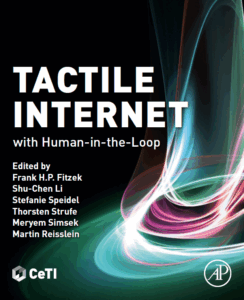
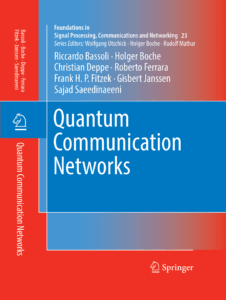
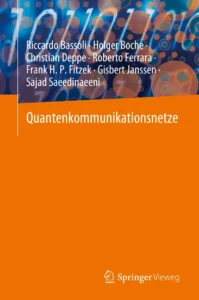
Most of the content of the lectures comes from our recently-published scientific articles and books.

Related Publications
2024
Halder, Joy; Rajabov, Akhmadjon; Bassoli, Riccardo; Fitzek, Frank H. P.; Fettweis, Gerhard P.
Optimal Routing and End-to-End Entanglement Distribution in Quantum Networks Journal Article
In: Scientific Reports, vol. 14, no. 19262, pp. 1-14, 2024.
@article{Halder24:OptimalRouting,

title = {Optimal Routing and End-to-End Entanglement Distribution in Quantum Networks},

author = {Joy Halder and Akhmadjon Rajabov and Riccardo Bassoli and Frank H. P. Fitzek and Gerhard P. Fettweis},

doi = {10.1038/s41598-024-70114-1},

year  = {2024},

date = {2024-08-20},

urldate = {2024-08-20},

journal = {Scientific Reports},

volume = {14},

number = {19262},

pages = {1-14},

keywords = {},

pubstate = {published},

tppubtype = {article}

}
2023
Lengerke, Caspar; Hefele, Alexander; Cabrera, Juan A.; Reisslein, Martin; Fitzek, Frank H. P.
Beyond the Bound: A New Performance Perspective for Identification via Channels Journal Article
In: IEEE Journal on Selected Areas in Communications, vol. 41, iss. 8, pp. 2687-2706, 2023.
@article{lengerke2023beyondthebound,

title = {Beyond the Bound: A New Performance Perspective for Identification via Channels},

author = {Caspar Lengerke and Alexander Hefele and Juan A. Cabrera and Martin Reisslein and Frank H. P. Fitzek},

doi = {10.1109/JSAC.2023.3288239},

year  = {2023},

date = {2023-06-21},

urldate = {2023-06-21},

journal = {IEEE Journal on Selected Areas in Communications},

volume = {41},

issue = {8},

pages = {2687-2706},

publisher = {IEEE},

keywords = {},

pubstate = {published},

tppubtype = {article}

}
Hofmann, Pit; Cabrera, Juan A.; Krieg, Elisha; Bassoli, Riccardo; Fitzek, Frank H. P.
DNA-Storage in Future Communication Networks Journal Article
In: IEEE Communications Magazine, vol. 61, iss. 10, pp. 178-183, 2023.
@article{Hofmann2023DNA,

title = {DNA-Storage in Future Communication Networks},

author = {Pit Hofmann and Juan A. Cabrera and Elisha Krieg and Riccardo Bassoli and Frank H. P. Fitzek},

doi = {10.1109/MCOM.011.2200755},

year  = {2023},

date = {2023-05-08},

urldate = {2023-01-01},

journal = {IEEE Communications Magazine},

volume = {61},

issue = {10},

pages = {178-183},

keywords = {},

pubstate = {published},

tppubtype = {article}

}
Lengerke, Caspar; Hefele, Alexander; Cabrera, Juan A.; Kosut, Oliver; Reisslein, Martin; Fitzek, Frank H. P.
Identification Codes: A Topical Review with Design Guidelines for Practical Systems Journal Article
In: IEEE Access, vol. 11, pp. 14961-14982, 2023.
@article{lengerke2023idcodes,

title = {Identification Codes: A Topical Review with Design Guidelines for Practical Systems},

author = {Caspar Lengerke and Alexander Hefele and Juan A. Cabrera and Oliver Kosut and Martin Reisslein and Frank H. P. Fitzek},

doi = {10.1109/ACCESS.2023.3244071},

year  = {2023},

date = {2023-02-10},

urldate = {2023-01-01},

journal = {IEEE Access},

volume = {11},

pages = {14961-14982},

keywords = {},

pubstate = {published},

tppubtype = {article}

}
Hofmann, Pit; Cabrera, Juan A.; Bassoli, Riccardo; Reisslein, Martin; Fitzek, Frank H. P.
Coding in Diffusion-Based Molecular Nanonetworks: A Comprehensive Survey Journal Article
In: IEEE Access, pp. 1-1, 2023.
@article{Hofmann2023Coding,

title = {Coding in Diffusion-Based Molecular Nanonetworks: A Comprehensive Survey},

author = {Pit Hofmann and Juan A. Cabrera and Riccardo Bassoli and Martin Reisslein and Frank H. P. Fitzek},

doi = {10.1109/ACCESS.2023.3243797},

year  = {2023},

date = {2023-01-01},

urldate = {2023-01-01},

journal = {IEEE Access},

pages = {1-1},

keywords = {},

pubstate = {published},

tppubtype = {article}

}
Nande, Swaraj Shekhar; Paul, Marius; Senk, Stefan; Ulbricht, Marian; Bassoli, Riccardo; Fitzek, Frank H. P.; Boche, Holger
Quantum Enhanced Time Synchronisation for Communication Network Journal Article
In: Computer Networks, 2023.
@article{nande_CN_2023,

title = {Quantum Enhanced Time Synchronisation for Communication Network},

author = {Swaraj Shekhar Nande and Marius Paul and Stefan Senk and Marian Ulbricht and Riccardo Bassoli and Frank H. P. Fitzek and Holger Boche},

doi = {10.1016/j.comnet.2023.109772},

year  = {2023},

date = {2023-01-01},

urldate = {2023-01-01},

journal = {Computer Networks},

keywords = {},

pubstate = {published},

tppubtype = {article}

}
2021
Adamo, Stephen Di; Nötzel, Janis; Sekavčnik, Simon; Bassoli, Riccardo; Ferrara, Roberto; Deppe, Christian; Fitzek, Frank H. P.; Boche, Holger
Integrating Quantum Simulation for Quantum-Enhanced Classical Network Emulation Journal Article
In: IEEE Communications Letters, 2021.
@article{9548923,

title = {Integrating Quantum Simulation for Quantum-Enhanced Classical Network Emulation},

author = {Stephen Di Adamo and Janis Nötzel and Simon Sekavčnik and Riccardo Bassoli and Roberto Ferrara and Christian Deppe and Frank H. P. Fitzek and Holger Boche},

doi = {10.1109/LCOMM.2021.3115982},

year  = {2021},

date = {2021-09-27},

urldate = {2021-09-27},

journal = {IEEE Communications Letters},

keywords = {},

pubstate = {published},

tppubtype = {article}

}
Bassoli, Riccardo; Fitzek, Frank H. P.; Strinati, Emilio Calvanese
Why do we need 6G? Journal Article
In: ITU Journal on Future and Evolving Technologies, vol. 2, no. 6, 2021.
@article{9475166,

title = {Why do we need 6G?},

author = {Riccardo Bassoli and Frank H. P. Fitzek and Emilio Calvanese Strinati},

url = {https://www.itu.int/pub/S-JNL-VOL2.ISSUE6-2021-A01},

doi = {https://www.itu.int/en/journal/j-fet},

year  = {2021},

date = {2021-09-13},

urldate = {2021-09-13},

journal = {ITU Journal on Future and Evolving Technologies},

volume = {2},

number = {6},

keywords = {},

pubstate = {published},

tppubtype = {article}

}
Ferrara, Roberto; Bassoli, Riccardo; Deppe, Christian; Fitzek, Frank H. P.; Boche, Holger
The Computational and Latency Advantage of Quantum Communication Networks Journal Article
In: IEEE Communications Magazine, vol. 59, no. 6, pp. 132-137, 2021.
@article{Bassoli21:AdvantagesQuantum,

title = {The Computational and Latency Advantage of Quantum Communication Networks},

author = {Roberto Ferrara and Riccardo Bassoli and Christian Deppe and Frank H. P. Fitzek and Holger Boche},

doi = {10.1109/MCOM.011.2000863},

year  = {2021},

date = {2021-01-01},

journal = {IEEE Communications Magazine},

volume = {59},

number = {6},

pages = {132-137},

keywords = {},

pubstate = {published},

tppubtype = {article}

}
Problem Based Learning
The course offers hands-on learning on the topics discussed in the “Communication Networks 3” course using a problem-based learning approach.
The course is organized as follows:
- Introductory part (1-2 meetings): We introduce the course and the problem-based learning approach. In addition, the chair members (supervisors) will offer ideas for projects.
- Forming teams and projects selection (1-2 meetings): Every 2-4 students form a team, select a project, meet the supervisor, finalize the project description.
- Project supervision and on-demand lectures (3-6): The students implement the projects and keep the supervisors updated. According to the topics of the selected projects, some lectures and exercises will be organized on demand (TBA). A project report must be submitted till TBD.
- Presentations (2-3 meetings): Team members present their project. Attendance of all presentations is mandatory.
Please attend the first 3 meetings to know the arrangement of the projects.
At a glance
Module Number: ET-12 10 20
Type: elective course
Semester: 9th semester ET
Term: annually in winter semester
Language: English
Extent: 2/1/0
Exam: report and presentation
Credits: 7 (in combination with ComNets3)
Lecturers and Teaching Assistants

12/2025 – 01/2026
Project consultation + On-demand lectures
linked to ComNets3
in sync with individual project supervisors
Traffic Theory/Nachrichtenverkehrstheorie
This course offers the theoretical base and practical methods for modelling, analysis, and performance investigation of communication systems. The students will learn how to use known formulas for traffic theory problems. The abstraction from reality to model will be done for different practical applications and networks.
Topics covered are:
- Introduction and Examples
- Probabilities, Random Distributions, Moments, Properties of distributions
- Random processes
- System modelling using traffic theory, terminology, classification, performance measures
- Little’s law, PASTA, BASTA
- Theory of Marcov chains (discrete and continous time)t
- Examples of communication systems to be analyzed with Markov chains
- Outlook on further tools (matrix analysis, fluid-flow, software tools, Jackson networks, Gordon-Newell, BCMP, Mean value analysis, network calculus (deterministic, stochastic)
Exercises will be on discussion base between students and teaching assistant to focus on unsolved problems.
At a glance
Module Number: ET-12 10 05
Type: elective course
Semester: 8th Semester ET
Term: annually in summer semester
Language: German/English
Extent: 2/1/0
Exam: written, 120 min
Credits: 7 (together with ComNets 2)
Lecturers and Teaching Assistants
30.04.2026
11:10
L5 – Momente und Stochastische Funktionen
Flip Class Room – Slides in OPAL
Flip Class Room
Study at home
05.05.2026
11:10
L6 – Markovketten mit diskreter Zeit
Flip Class Room – Slides in OPAL
BAR S4
Discussion on L5/L6
14.05.2026
Ascension Day
— no lecture —
19.05.2026
L7 – Markovketten mit diskreter Zeit – Teil 2
Flip Class Room – Slides in OPAL
Flip Class Room
Study at home
26.05.2026
Pentecoast Week
— no lecture —
28.05.2026
Pentecoast Week
— no lecture —
21.07.2026
11:10
L14 – Funktionaltransformationen und das M/GI/1/infty – System
Last lecture, Recap
17. – 19.08.2026
to be defined
Consulting, Briefing, Coaching, Questions
E8 – Prüfungsaufgaben 2
t.b.d.
to be defined
19.-21.8.2026
Exam
t.b.d.
ICT for Smart Grids/Informations- und Kommunikationstechnik
The course ICT for Smart Grids is offered for students in the module “Kommunikationstechnik” from the Renewable Energy Systems studies. It is linked to the course “Kommunikationsnetze” in this module as well.
The course focuses on communication technologies specific to IoT scenarios (ZigBee, LoRa), Application Layer IoT protocols (MQTT, COAP), data management systems and an introduction to datatbase design, data analysis (traditional and machine learning based), and security.
From this course, students will learn how to approach the design of a distributed and remotely controlled system, from the selection of the communication technology, to the application data management and privacy.
At a glance
Module Number: RES-WK-45
Type: elective course
Semester: 8th Semester RES
Term: annually in summer semester
Language: English, German
Extent: 2/2/0
Exam: written, 150 min
Credits: 7 (together with ComNets 1)
Lecturers and Teaching Assistants
03.06.2026
13:00
Communication Network & Mobilities for EU project
M.Sc. Christopher Lehmann & MPA Shangqing Wang
24.06.2026
14:00-15:30
Appointment for visiting SachsenNetze / DigiMeto
Zschoner Ring 3,
OT Kesselsdorf, 01723 Wilsdruff